Been a
poorly kept secret, so many of you know. But for those that don't, I
have stopped publishing California Paddler/California Kayaker Magazine.
I enjoyed running it for the 4 years we published, but had to pull the
plug as it just wasn't making financial sense.
I wanted to put out a thanks to the many people who helped (often unpaid) bring this magazine to life. Eric Bloom (editing/proofing), Karen Lapinski (editing/proofing/legal/reviews), Laura Ramos (initial layout/editing/proofing), Elizabeth Rowell (photo editing/California Paddler logo), Brian Warkentine (California Kayaker logo), and Sylvia Wu (editing/proofing/reviews). And to all the authors and photographers who provided content. And to the people at the retailers/tour companies who loved the magazine so much to make space to give it out to their customer. And, of course, the companies who believed in the benefit of advertising in the magazine enough to lay out their hard earned cash for advertisements. The magazine definitely took a community to be possible.
I am open to
bringing it back at some point in the future (maybe as an online only
magazine), but am not actively working on that.
The calpaddlermag.com/calkayakermag.com web site will be kept up so people can read back issues. And the facebook.com/CalPaddlerMag and facebook.com/CalKayakerMag pages will be keep up so we can keep posting news and items of interest.
Peter
(ex-)Publisher/Editor

Friday, February 28, 2014

Sunday, January 26, 2014
Sea Kayaking with Gordon Brown Volume 3 review

Gordon Brown is one of Scotland’s
premier instructors. He has the highest achievable certification from the
British Canoe Union, and is the only American Canoe Association certified coach
in Scotland. He has also been a guest instructor at the last 2 Golden Gate Sea
Kayak Symposiums (and will be at the next GGSKS next weekend). Gordon owns and operates Skyak Adventures on the Isle of Skye.
Sea Kayaking with Gordon
Brown Volume 3 is the third and last video
in a 3 part series. Sea Kayaking with Gordon Brown Volume 1 video covers
the foundations of sea kayaking – paddling, turning, steering, edging, etc. California
Kayaker reviewed the first video on our blog at
Sea Kayaking with Gordon Brown
Volume 2 moves
to more advanced materials, covering assisted
and self rescues, tows, technical landings and launches, and
anticipating/avoiding troubles. This DVD
was reviewed in the Spring 2012 issue of California Kayaker Magazine, which can
be read online at www.calpaddlermag.com/magazine.html.
Volume 3 continues to move to more advanced content. It has 4 sections:
- Handling Emergency Situations
- Sea Kayak Navigation
- Rolling Clinic
- First Aid Kits
Preview for the Volume 3 video:
Volume 3, Sea Kayak with Gordon Brown from Simon Willis on Vimeo.
Here are our thoughts looking at each section:
Handling Emergency
Situations
The video uses a mock rescue to present safety planning, how
to deal with an emergency, and what to expect if rescue services are contacted.
The big picture main points of the segment apply to all paddlers: be prepared
with signaling equipment, training and practice; paddlers should be prepared to
address emergencies themselves until help is available; equipment for
contacting emergency services, what it does, how to use it, and the limitations;
making yourself visible to searchers. The video also discusses complications
such as being unfamiliar with rescue equipment and working with cold hands.
We thought about this hard and feel that the US Coast Guard
rescue procedures are similar to Her Majesty's Coast Guard and the Royal
National Lifeboat Institution, but a US paddler might not want to rely too
heavily on some of the details presented just in case there are differences.
Sea Kayak Navigation
This segment is less location-specific than the first, but
does talk about OS Maps, which seem to be the UK equivalent to Topo maps. The
graphics were very helpful in explaining tides and correcting bearing for tide
flow. A bonus is the explanation of why the most extreme tide periods are
called spring tides even though they occur every 14 days. The presenter gives
several rules of thumb to use in predicting tidal action. The night navigation
is worth watching because, as the video points out, paddlers risk finding
themselves paddling at night no matter what their float plan is.
Rolling Clinic
Rolling seems to be one of the most difficult kayak skills
to present on a video, and the video points out that rolling cannot be learned
by watching a video, but has to be learned in a boat. Gordon's video is one of
the best because it is filmed in clear pool water with multiple camera angles (including
what one reviewer called the "crotch view") showing the same move.
There were a couple of methods Gordon used that I would try,
either while practicing my roll or helping someone. The video shows how a coach
can assist the paddler while sitting on the side of the pool. When a paddler
completed his first roll, instead of immediately making another attempt, Gordon
suggested he get out of the boat, sit with his eyes closed, and think about
what was happening during the roll.
I am not so sure video feedback would be as useful, and even
Gordon says it can be difficult to find one correction to concentrate on when
the video may show the paddler making several mistakes.
First Aid Kits
First Aid kits are like tow ropes - everyone should have
one, but if you put 5 kayakers together, you will get 6 opinions on what you
should use. Still, there is useful information in this segment, with the key
points being the importance of training for how to respond to an emergency and
how to use the items in the kit; consider carrying a minimal kit close at hand
and larger kit in a hold; and items to carry in the first aid kits.
You do not need to watch any of the prior volumes to get
benefit from the other volumes.
Who should buy Volume 3?
We thought about this a bit. Volume
1 would be good for any sea kayaker (and even for people who paddle other types
of kayaks). The second gets more
specific for sea kayakers, and in some cases specific for group coastal
paddling, yet still is generally useful.
This video, volume 3, gets very specific to some areas of sea kayaking,
and has a bit more limited market. There
definitely are skills to be gained for anyone paddling a sea kayak, even if paddling on protected
lakes, but the topics covered are best for people who do expeditions, paddle in
areas with currents, and in groups. If you fall into one of these categories,
get it. But if not and you don't have an
extra $30 in your pocket, maybe hold off on this one (or spend it on volume 1
or 2, if you don't have those).
This DVD has 2.5 hours worth of content. It costs $29.95 and is available for purchase
from your local paddlesports shop or online from www.seakayakwithgordonbrown.com.
Friday, November 8, 2013
Apps to read California Paddler Magazine on tablets
Have a tablet and want to read the magazine. You can always download the PDF from calpaddlermag.com/magazine.html. Or now you can use specific apps to read the magazine.
For Android tablets, you can download the California Paddler Magazine app from the Google Play Store. This app has all published magazines loaded in it, so they can be read at any time. And automatically adds new issues as they come available.
For iPad users, you can download an app called Coverly from iTunes. This app lets you read many free magazines, including California Paddler Magazine.
Thursday, June 20, 2013
Summer 2013 Issue of California Paddler Magazine is now Published

Contents include How to Buy a SUP, Blending Strokes for Improved Performance, Paddling with Kids, Big Bear, Ocean-Going Native American Plank Canoe, reviews of the This is the Sea 5 DVD, Rock the Boat DVD, and BC Coast Explorer Guide Book and much more...
About California Paddler Magazine:
California Paddler Magazine (formerly California Kayaker Magazine) is a print and online magazine focusing on being the source for paddlesports information for the Southwest. We are dedicated to promoting fun and responsible paddling, and advocating for increased paddling opportunities in this region.
The stories in California Paddler Magazine are written by local experts and include articles on places to paddle, tips on how to improve your paddling experience, and information of concern to paddlers and the local paddling environment. Covers all types of paddlesports (sea kayaking/touring, white water, surfing, fishing, stand up paddling, canoeing, etc.) and for paddlers of all levels (those entering the sport to pros).
More information on the magazine can be found at www.calpaddlermag.com
Friday, April 12, 2013
California Kayaker Magazine renamed to California Paddler Magazine
Here is a press release for the upcoming name change from California Kayaker Magazine to California Paddler Magazine.
FOR IMMEDIATE RELEASE:
California Kayaker Magazine Changes Name to California Paddler Magazine
San Francisco, CA — April 12, 2013 — Starting with the Summer 2013 issue (#11), California Kayaker Magazine will be published under the name California Paddler Magazine.
By changing the name from "kayaker" to "paddler" the magazine seeks to expand the content to cover all paddle sports. “Canoes and rafts have somewhat limited retail markets in our geography, so likely will only be covered from time to time,” said Peter Donohue, California Kayaker Magazine’s Editor, “but with this change we do plan to have stand up paddleboard (SUP) content in each issue, reflecting its fast growth and popularity.”
Donohue also said that beyond the addition of SUP, the rest of the magazine will not see major changes. “We will continue to print on high quality paper stock, distribute through all the same locations – with the addition of SUP-specific retailers, print on the same schedule for 2013, increasing to 3 issues for 2014." – he added. “And keeping our loyal kayaking readers in mind we will continue to include great kayak content in each issue."
Donohue offered that the first SUP article will be about the different types of SUPs (displacement boards versus planing boards, etc.), written by Scotto of Clavey Paddlesports, a past contributor to the magazine.
About California Paddler Magazine:
California Paddler Magazine (formerly California Kayaker Magazine) is focused on being the South West's source for paddle sports information. We cover all forms of paddle sports (SUP, kayaking, canoeing, etc.) and for readers ranging from those just entering the sport to professionals. California Paddler is printed on glossy stock and packed with photos and stories written by local experts. Articles include trip experiences, skills, product reviews, news, how to get started, etc. Print runs exceed 10,000 copies per issue, which are distributed free at paddle sports, general sports, and boating outlets in California, Oregon, Arizona, and Nevada. Each issue is also available to be read online.
FOR IMMEDIATE RELEASE:
California Kayaker Magazine Changes Name to California Paddler Magazine
San Francisco, CA — April 12, 2013 — Starting with the Summer 2013 issue (#11), California Kayaker Magazine will be published under the name California Paddler Magazine.
By changing the name from "kayaker" to "paddler" the magazine seeks to expand the content to cover all paddle sports. “Canoes and rafts have somewhat limited retail markets in our geography, so likely will only be covered from time to time,” said Peter Donohue, California Kayaker Magazine’s Editor, “but with this change we do plan to have stand up paddleboard (SUP) content in each issue, reflecting its fast growth and popularity.”
Donohue also said that beyond the addition of SUP, the rest of the magazine will not see major changes. “We will continue to print on high quality paper stock, distribute through all the same locations – with the addition of SUP-specific retailers, print on the same schedule for 2013, increasing to 3 issues for 2014." – he added. “And keeping our loyal kayaking readers in mind we will continue to include great kayak content in each issue."
Donohue offered that the first SUP article will be about the different types of SUPs (displacement boards versus planing boards, etc.), written by Scotto of Clavey Paddlesports, a past contributor to the magazine.
About California Paddler Magazine:
California Paddler Magazine (formerly California Kayaker Magazine) is focused on being the South West's source for paddle sports information. We cover all forms of paddle sports (SUP, kayaking, canoeing, etc.) and for readers ranging from those just entering the sport to professionals. California Paddler is printed on glossy stock and packed with photos and stories written by local experts. Articles include trip experiences, skills, product reviews, news, how to get started, etc. Print runs exceed 10,000 copies per issue, which are distributed free at paddle sports, general sports, and boating outlets in California, Oregon, Arizona, and Nevada. Each issue is also available to be read online.
Thursday, February 21, 2013
Spring 2013 issue is published
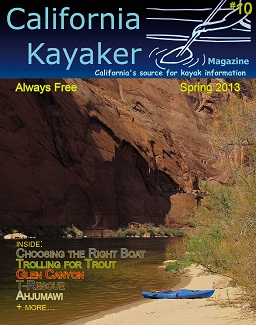
Contents include solo trip on Glen Canyon, paddling Ahjumawi State Park and Fall River area, Trolling for Trout, the basic types of kayaks, T-Rescue skills, Sportsman’s Best - Kayak Fishing book review, and much more...
About California Kayaker Magazine:
California Kayaker Magazine is a print and online magazine focusing on being the source for kayaking information for California. We are dedicated to promoting fun and responsible kayaking, and advocating for increased paddling opportunities in this region.
The stories in California Kayaker Magazine are written by local experts and include articles on places to paddle, tips on how to improve your paddling experience, and information of concern to paddlers and the local paddling environment. Covers all types of kayaking (touring, white water, surfing, fishing, etc.) and for paddlers of all levels (those entering the sport to 5 star paddlers).
More information on the magazine can be found at www.calkayakermag.com
Tuesday, October 30, 2012
2013 California Kayaker Magazine Plans
2013 is coming together for California Kayaker
Magazine. There will be 2 issues - a Spring (published end of
February) and Summer (end of June). Content is starting to be lined up now.
Advertising info is also set, and can be seen at http://www.calkayakermag.com/advertise.html. Prices have been held the same as 2012 (and even lowered slightly for those who commit to advertising in both issues).
Advertising info is also set, and can be seen at http://www.calkayakermag.com/advertise.html. Prices have been held the same as 2012 (and even lowered slightly for those who commit to advertising in both issues).
Tuesday, September 4, 2012
Safety kayaker for Alcatraz swims?
Along with being editor of California Kayaker Magazine, I
act as a kayak safety boater for over a dozen open water swims each year. In doing this, I have seen all sorts of things, both good and bad, from the other kayak safety boaters, so wanted to post some info to help kayakers understand
what is expected of them should they sign up to be a safety boater.
 This is targeted for kayakers doing safety boating
for the large Alcatraz swims. Specifically,
the swims that go from Alcatraz and land some place between Marina Green and
Crissy Field (click on the picture to left to see large size). Events like Alcatraz Aquathlon, Escape from
Alcatraz Triathlon, SF Triathlon at Alcatraz, etc. These events take place
during strong ebb tides and call for many kayak safety boaters.
This is targeted for kayakers doing safety boating
for the large Alcatraz swims. Specifically,
the swims that go from Alcatraz and land some place between Marina Green and
Crissy Field (click on the picture to left to see large size). Events like Alcatraz Aquathlon, Escape from
Alcatraz Triathlon, SF Triathlon at Alcatraz, etc. These events take place
during strong ebb tides and call for many kayak safety boaters.There are many other open water swims in the Bay (Alcatraz to Aquatic Park swims, Bridge to Bridge swims, trans-Golden Gate Bridge swims, etc.), and the specifics of the strong ebb tide and its impacts may not be relevant for those events (though they too generally have their own impacts from tides and currents).
Should you be there?
Tidal currents form tide rips where the moving water hits other currents,
land, or underwater rocks. The main impact of tide rips on safety boaters is
that they form waves. Add in wakes from
power boats (and big ships), wind waves, and such, and you have a challenging place in which to be
paddling. The video to the right shows the type of waves that are common. Much larger waves than those shown here do occur (but are too large for me to hold a camera while keeping myself upright), and you need to be prepared for them.
So safety kayakers need to be prepared, both with appropriate skill and appropriate equipment, to deal with waves. It is unfortunately common for a safety boater to sign up and get to the mouth of Aquatic Park only to see the harsher bay conditions for the first time and decide it is not for them. And they bail out. This is not fair to the event organizers, who are counting on kayakers to be able to do their job.
 Worse are those who go out and then need to be rescued. The rescuers are generally other kayakers,
which means that both the rescuers and rescuee are now unavailable to work
the event. This compromises the safety of the swim doubly.
Worse are those who go out and then need to be rescued. The rescuers are generally other kayakers,
which means that both the rescuers and rescuee are now unavailable to work
the event. This compromises the safety of the swim doubly.So, you need a boat that can handle the conditions, and the knowledge and experience to know you can also.
 On boats, sea kayaks or sit on top kayaks are most
common. Both have pros and cons, but the
main similarity is that if you get knocked out of either, the boats will still
float. Recreational type boats, those wide
boats with large open cockpits, are not recommended, as they have limited built
in floatation which may not allow you to get back in should the cockpit be filled with water. Of course, this assumes you know how to get back in/on to whatever boat you use should you flip over...
On boats, sea kayaks or sit on top kayaks are most
common. Both have pros and cons, but the
main similarity is that if you get knocked out of either, the boats will still
float. Recreational type boats, those wide
boats with large open cockpits, are not recommended, as they have limited built
in floatation which may not allow you to get back in should the cockpit be filled with water. Of course, this assumes you know how to get back in/on to whatever boat you use should you flip over... Once you have chosen your boat, you should also have
experience being in conditions similar to what you might see. Do not choose to support a swim in order to find out if you can handle the rougher conditions. You should have experienced them before and know you can do it.
Once you have chosen your boat, you should also have
experience being in conditions similar to what you might see. Do not choose to support a swim in order to find out if you can handle the rougher conditions. You should have experienced them before and know you can do it.Even with the boat and knowledge, you should be self sufficient. The saying with kayaking is to dress for the water temperature (which in the SF Bay is very cold). Wear clothing that will keep you safe and comfortable even if you do end up taking an unexpected swim, and have snacks and water with you to keep yourself fueled.
Effect of ebb on kayakers - getting out to the start
Along with creating waves, the moving water from the ebb
tide also, well, moves. It is going from
the bay towards the ocean, usually at about 3 mph. You need to cross this current to get from
the launch at Aquatic Park to the waiting point at Alcatraz. The current is going around 3 mph, and a cruising speed for
a kayak is also around 3 mph. So if you
point your boat straight to Alcatraz, which is about a mile from the mouth of
Aquatic Park, and then paddle, you will end up a mile to the west of Alcatraz.
The solution is two fold:
- First thing is not to exit the mouth of Aquatic Park, but paddle inside the breakwater to the entrance by the Jeremiah O'Brien (watching out for other boat traffic, of course). This moves you a bit upstream of Alcatraz
- Don't paddle straight to the island, but instead aim your boat towards Richmond or Berkeley or so (so Alcatraz is at about 10 o'clock). This is called a ferry angle, and an example of it can be seen in the video to the right. Your boat won't be pointed to Alcatraz, but you will be going there. To check to see that you are making it there, you should take a "range" off of Alcatraz and Angel Island. For info on what a range is and how to do it, you can read the section on ranges in this post on the Tsunami Ranger blog.
If you do miss and end up west of Alcatraz, you will have a fight to get to the start. Remember you average 3 mph and the current is going 3 mph. One option is to sprint, but this is exhausting. A better option is to use the eddy formed west of Alcatraz. Alcatraz blocks the water flow, and there is a shadow in the current west of there where the current is not going out the gate, but actually is a back current heading toward Alcatraz. If you get in this, you will get a ride to the island. Look for the change in the waves (they get larger and choppier) and for a line of trash and sea foam paralleling the current, which will mark the eddy line. Cross this line and ride the flow back toward the jump point.
Effect of ebb on swimmers
If you think it is hard to paddle to Alcatraz, it is even harder to swim. Swimmers only go about 1-2 mph, versus the 3 mph ebb. This means that they are moving faster
sideways toward the Golden Gate Bridge than toward San Francisco. This is done on
purpose - the finish is way to the west of the jump point, so a slow swimmer
can swim straight south toward San Francisco and the current would move them west to the finish.
No swimmer can aim directly toward the finish. The pros up
front generally know what they are doing, so rarely are an issue. But the slower the swimmer, the more south
(directly toward the closest part of San Francisco) they need to aim.
The problem is that even though the swimmers are told
this, many either forget or didn't listen, so try to swim directly toward the
finish. By not taking into
account the ebb tide current, they are pushed west quickly. And the current is faster than they can swim. Once they get too far west, their only option is to get pulled out by a
powerboat. Corralling the swimmers who head too far west is a lot of work for the safety kayakers, and can't be fun for the swimmers who are constantly being told to correct their course, but it is even more disappointing for the swimmers when they get pulled.
If the swimmers are only slightly west, they may still be able to finish (particularly if the finish is Crissy Field) by swimming to the beach west of the finish and then running to the finish.
Swim coach Leslie of Swim Art Open Water Swimming emphasizes "It is extremely important to guide the medium to slow swimmers STRAIGHT SOUTH on this type of swim, particularly those on the west side of the pack. They should never be aiming directly toward the finish point."
Other Swimmer Issues
Many people doing these swims have never swum in open water before. The experience is a bit different than a pool
or a lake for them. Some of the impacts
you will find are:
- Being low in the water, swimmers can't see where to swim to. The waves in the bay prevent them from seeing things low to the water. So when you give them landmarks to swim to, choose tall things. Tall buildings are generally good.
- They don't always swim straight - in pools, they have lane lines above and below to follow, but these don't exist in the bay. You will have to tell some swimmers repeatedly what direction to swim. Some will do circles if left alone.
- The rules usually allow swimmers to hang on to your boat to rest, if they need. The way to do this is to have them go to the front (or sometimes back, but then you can't see them) of your boat and hold on there. If they grab you from the side, they could pull down and flip you over. You should instruct the swimmer where on your boat to hold on to.
- If someone needs to be pulled, the standard thing to do is hold your paddle straight up. This is a signal to the safety jet skis and power boats to come over (as shown in video above). The jet skis are often busy, so be prepared to wait for a few minutes with your paddle up until one gets to you.
- Swimmers won't be able to hear well, so you will have to speak loudly. Coach Jake of Waterworld puts it well: "Speak loud, with authority, and short and direct. Keeping in mind adjusting swimmers is not a personal issue, you are talking to them so they can hear. Verbal shouting matches rarely work. Remember that sometimes adrenaline can get going and the swimmer may engage, so it is important to be calm, collected and firm." Loud and informative, not yelling and arguing. And if the swimmer continually won't follow your instructions and it really matters (such as they will get flushed past the finish), then escalate to having a power boat or jet ski talk to them.
Definitely pay attention at the kayaker safety briefing before the swim. The info I posted here is generally true for most events, but some events may have specific rules or changes you should need to be aware of.
Summary
There are a lot of reasons to be a kayak safety boater for a
swim - it is fun, you see other kayakers, you are given a stipend which offsets
the costs of getting to the water, and you help hundreds of swimmers achieve their goals and dreams of swimming from Alcatraz. But you should only do it if you are prepared to handle the conditions.
Sunday, July 22, 2012
Local Access TV Interview - "Darlene Carmen Presents"
I was interviewed on a local access TV show that plays in the San Jose area called "Darlene Carman Presents". They interviewed me on kayaking and the magazine. Neither of the interviewers had ever kayaked, which made it both challenging and good. Challenging in that the questions seemed to come out of the blue, but good in that it forced me to talk about kayaking at a level of someone who doesn't, which is really what their viewers likely are.</p>
The show can be viewed online at http://www.creatvsj.org/Show.aspx?show=14852.
In the interview, they talk about more videos of mine that one can watch. These can be seen on my Youtube page.
The show can be viewed online at http://www.creatvsj.org/Show.aspx?show=14852.
In the interview, they talk about more videos of mine that one can watch. These can be seen on my Youtube page.
Sunday, July 1, 2012
Summer 2012 issue is published

Contents include Kayaking & Small Living Places, Forward Stroke, SUP for Kayakers, Eel River Headwaters to Sea, Santa Monica, Book Excerpt “With the Sea Beside Me”, Book Review: “Sea Kayaking the Redwood Coast”, and much more...
About California Kayaker Magazine:
California Kayaker Magazine is a print and online magazine focusing on being the source for kayaking information for California. We are dedicated to promoting fun and responsible kayaking, and advocating for increased paddling opportunities in this region.
The stories in California Kayaker Magazine are written by local experts and include articles on places to paddle, tips on how to improve your paddling experience, and information of concern to paddlers and the local paddling environment. Covers all types of kayaking (touring, white water, surfing, fishing, etc.) and for paddlers of all levels (those entering the sport to 5 star paddlers).
More information on the magazine can be found at www.calkayakermag.com
Friday, March 16, 2012
California Kayaker Magazine - Spring 2012 issue
The Spring 2012 issue of California Kayaker Magazine has been published.
Contents include Getting Butt Time, Big Sur Learnings, Critters from Kayaks: White Pelicans, Interview with Surf Kayaker Rachael Krugman, Petaluma to Napa by Surf Ski, Building Your Own Kayak Primer, Review of the Gordon Brown Rescue DVD, a must-see Center Hatch photo, and much more...
About California Kayaker Magazine:
California Kayaker Magazine is a print and online magazine focusing on being the source for kayaking information for California. We are dedicated to promoting fun and responsible kayaking, and advocating for increased paddling opportunities in this region.
The stories in California Kayaker Magazine are written by local experts and include articles on places to paddle, tips on how to improve your paddling experience, and information of concern to paddlers and the local paddling environment. Covers all types of kayaking (touring, white water, surfing, fishing, etc.) and for paddlers of all levels (those entering the sport to 5 star paddlers).
More information on the magazine can be found at www.calkayakermag.com
Friday, February 10, 2012
Sea Kayaking with Gordon Brown Volume 1 – Sea Kayak Handling

Gordon Brown is one of Scotland’s premier instructors. He has the highest achievable certification by the British Canoe Union, and is the only American Canoe Association certified coach in Scotland. This is his second video production, having produced a sea kayak rescue video “Over… and Out” in 1993. He also has a third DVD on rescues and towing which California Kayaker will be reviewing shortly (and has plans for a fourth on navigation). He is the author of Sea kayak – A Manual for Intermediate and Advanced Kayakers. Gordon owns and operates Skyak Adventures on the Isle of Skye.
The Sea Kayaking with Gordon Brown Volume 1 – Sea Kayak Handling video covers the foundations of sea kayaking – paddling, turning, steering, edging, etc.
They recommend watching the video in its entirety first, which switches between a chapter on a lesson and a chapter on paddling a stretch of the coast of The Isle of Skye. Then you can go back and re-review any instructional segments you need to. It is easy to select among the touring and lessons chapters from the main menu.
We followed this process when we viewed the DVD. Our reviewers enjoyed the first viewing because it showed an interesting area that we will not likely ever paddle. The alternating instruction and adventure chapters also kept either from getting tiresome.
The production quality of the video is very good. Very little wind noise or other background noises that many other kayaking videos have. The video quality is also quite good. They use an excellent mixture of on boat and on land cameras to make sure the right angle is provided to ensure the subject being talked about is understood.
The progression from paddler position in the boat to maneuvering around rocks and the presentation are logical and clear. Gordon does away with any right-left confusion by using red tape to identify the left side of the boat and paddle and green tape to identify the right side. Despite the clear progression and helpful use of colored tape, only the first two instructional chapters, paddler position and forward stroke, are for beginners. The entire DVD seems more geared toward intermediate and advanced paddlers and instructors.
One reviewer, an instructor for a local shop commented that “it is easy to pick up refinements in presentation from the video. For example, after the first viewing, I incorporated some of his instruction about boat edging versus boat lean in my class the following weekend.“
Overall, this video would be an excellent addition to a sea kayaker’s library. We don’t believe that any video could replace time in a class or 1-on-1 with a coach, but this video comes close.
Despite the generally good sound quality, there were a few words we missed. To help those of us who don’t understand the Scottish version of English, there is a free PDF transcript available from Gordon Brown's website.
Here is the trailer for this video:
You can purchase the Sea Kayaking with Gordon Brown Volume 1 – Sea Kayak Handling DVD at you local kayak shop for $29.95 or online from www.seakayakwithgordonbrown.com.
Friday, December 16, 2011
Body Boat Blade Sea Kayak Rescues video review
 Ok, anticipation was high when we received a copy of this DVD. Shawna Franklin and Leon Somme are co-owners of Body Boat Blade International, a kayak shop in the San Juan Islands of Washington that is well known for quality, high level instruction. The videographer is Bryan Smith of Reel Water Productions, who was behind the Pacific Horizons and Eastern Horizons films, both well done sea kayak porn worthy of adding to your library.
So, did the DVD live up to our expectations? Let's take a look at the good and the not so good:
The Good
The camera work and editing was excellent. The shots were clear, didn't look like they were taken through a salty lens, and the cameras were well-positioned. The look of the videos was better than most we've seen. And the sound was also excellent - no wind noise, appropriate volume, etc.
The opening scene of the paddler getting flushed out and separated from the kayak was a excellent way to catch the viewer's attention. And it was good to see rescues in challenging conditions. Classes generally teach how to rescue in flat water, but you aren’t as likely to wet exit in flat water as you are in waves and currents. Good reminder that we should practice the rescues in these tougher conditions.
The video had a good discussion of toggles and decklines – what they do and why you would want them.
The Not So Good
This video claims to “give all the tools” one would need, but we found that it doesn’t meet this goal. I guess that would be a tall order for a 30 minute long video (plus 5 minutes of extras). This video shows a variety of rescues in conditions varying from flat to advanced, but doesn’t provide the details one would need to learn these rescues from scratch.
If you are a novice paddler, watching this video may be good to show you the types of conditions that a sea kayak can be rescued in, but won’t do much to get you ready to do so. The Sea Kayak with Gordon Brown Volume 2 video, which also covers rescues, would be better. California Kayaker Magazine will be running a review of the Gordon Brown volume 2 video in the upcoming Spring 2012 issue (and the volume 1 video in a future blog post here).
We do think the Body Boat Blade Sea Kayak Rescue video shows much that an intermediate or advanced paddler could make use of, but they would likely need to watch it a few times to catch the details. For example, they sometimes use the heel-hook re-entry, sometimes the classic lunge on the back deck, and from time to time the swimmer will get back into their boat from between the two boats. Nothing is mentioned on when or why you would use one over the other, but it is good to see them done so you can get some info that will hopefully give you some things to try the next time you are doing rescue practice. No one rescue method works in all situations, so having multiple ways of doing a rescue in your repertoire is important.
You can take a look at the video’s trailer below:
Summary
Get it if you want a complete library of every sea kayak DVD out there. There are much worse ways to waste 30 minutes than watching this DVD.
Don't get it if you are looking for the 1 DVD that will teach you everything you need to know about rescues. The Gordon Brown video will be better for this, but in reality taking a rescue class would be much more useful, as they not just teach you, but also make you try the rescues.
Tuesday, November 15, 2011
Review - Cobra Surf Ski
This is the first of what we hope to be many reviews that will be posted on the California Kayaker Magazine blog. These reviews will be on various kayaking-related products that we weren't able to publish in the magazine for one reason or another, but are still on products that might be of interest to our readers.

This first product we are covering is the Cobra Surf Ski. Beyond the duck-billed platypus’s nose, what intrigued us was that it was made of rotomolded plastic. We though this might be a good entry-level surf ski – a boat that provides the speed and training benefits of a surf ski, using a more rugged material at an entry-level price.
First, what is a surf ski? Wikipedia describes them as “Typically 16½-21ft long and only 16-20" wide, surf skis are extremely fast when paddled on flat water (only an Olympic K1 or K2 kayak is faster) and the fastest paddled craft available over a long distance on ocean swells. They track well but are less maneuverable and have less transverse primary and secondary stability than shorter, wider craft. Despite its typical instability, a surf ski (with an experienced paddler) is a very effective craft for paddling in big surf. Its narrowness and length helps it cut or punch through large broken waves. Double bladed paddles are used, often with highly contoured wing blades for extra efficiency.”
Two reviewers tested out the boat. They were PD (6’ 220 lbs, surfski novice) and KL (5’5” 125 lbs, owns a Futura brand surfski which is used for fitness paddling).
Form and Fit:
PD: The boat fit me well, but there was not much more room to move the foot pegs for anyone much taller than I. I am also at the stated weight limit for the boat, but it seemed to work fine. Likely I was sitting lower in the water, so had a wetter ride, than someone lighter would have.
KL: The seat cup back was more comfortable than my Futura. It didn’t have a back band, and felt like it needed one less than my Futura (which doesn’t have one either). The seat bottom on the Cobra was a little uncomfortable, as I could feel it flexing and if felt like I was riding on my tailbone. Seat padding would probably fix this.
KL: The foot peg adjustments are great if you rarely adjust. Replacing the allen-head bolts with wing-bolts (like what is on the Futura) would make adjustments more convenient.
Performance:
 PD: The Cobra definitely feels like a surf ski–in other words, fast and tippy. In the half dozen times or so I have paddled it, I never flipped over, but it does feel unsteady until you get used to it. As I have often heard, surf skis are much more steady when you are moving, and that holds true for this boat also.
KL: The Cobra felt more stable than my Futura. It weighs about 10 lbs more and is a couple feet shorter. I didn’t do a head to head comparison, but it likely was somewhat slower than my Futura, as would be expected from a boat that is shorter, heavier, and wider. Still, it seemed to take much less effort to paddle it than to move my 68 lb sea kayak.
PD: I tracked speeds with a GPS and found that I was between 0.5 to 1.0 mph faster in the surf ski over a distance than I am in my 17’ 6” touring sea kayak. May not sound like much, but that is about a 20% increase in speed!
PD: We did do recovery practice to make sure that should we flip over, we would be able to get back on, and we were able to do a cowboy scramble type recovery. It takes a little more balance than a sea kayak, but with the low deck and being a sit on top, it in many ways is easier than doing this type of recovery in a sea kayak. For more information on how to do a cowboy scramble, see the skills article in Issue #7 published Fall 2011.
What is with that funny looking nose?
 Surf skis are said to have originated in Australia and used by lifeguards for surf rescues. One of the designs they came up with was a flared nose to prevent the bow from diving when surfing down large steep waves on the way back in to shore. Most currently made surf skis now are not used in surf zones, so don’t have this design.
 To see some surf skis with these noses being paddled in large surf (about the upper limit of what these boats should be used in), take a look at a video of an Australian race series at http://youtu.be/d-6gE-nZE1k. Probably not Cobra boats in the video, but ones with similarly funny looking bows...
Who should paddle this:
This does seem like it would be a good starter boat for someone who wants to try surf skis. You pay a bit less than composite boats, but get a heavier boat. For more advanced paddlers, with the plastic being more indestructible than composite, this could be a good trainer boat or for times when you will be in more aggressive conditions (such as in the surf).
Specifications:
Length: 17'4"
Width: 20"
Weight: 46 lbs.
Capacity: 220 lbs.
Subscribe to:
Posts (Atom)